
By Eric Ortiz (@EricOrtizG)
The so-called Butcher of Mons is a serial killer who is attributed with the murder of five women, whose remains were found in 1997, inside several garbage bags in the south of Belgium. To this day, authorities haven’t been able to identify the person responsible.
This true crime story was the starting point for the potent Belgian film Megalomaniac (2022), written and directed by Karim Ouelhaj. “This story is very mysterious in my country, we never found the guy,” Ouelhaj recalled in an interview for the Fantastic Pavilion and added that the case “was a lot on TV, it created a lot of fear in the population and a lot of mystery. You can imagine a lot of stories.”
Megalomaniac is not really a traditional film in the popular serial killer genre. For Ouelhaj, “there are a lot of stories about serial killers. I didn’t want to make a real serial killer film because there are a lot that I like. I can’t compare myself to Memories of Murder (Salinui chueok, 2003) or Se7en (1995), they’re too big. I like Silence of the Lambs (1991) and my favorite is Henry: Portrait of a Serial Killer (1986), but it was not really an influence for Megalomaniac. I’m from the Academy of Fine Arts, my inspiration is painting. I wanted to have a new angle, I used that Butcher of Mons story as a pretext. Megalomaniac is more about the phantasm.”
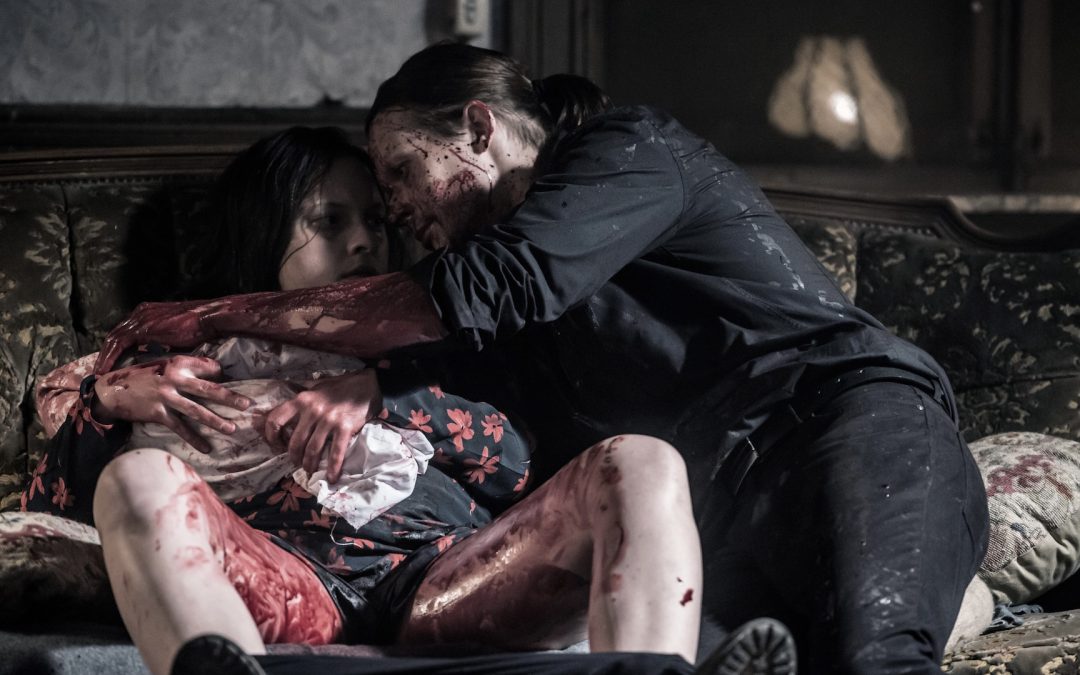
Ouelhaj imagined the children of the Butcher of Mons: Felix (Benjamin Ramon) and his younger sister Martha (Eline Schumacher). In the present, a couple of decades after the notorious case, Felix is practically following in his father’s atrocious footsteps: he stalks and brutally murders lonely women, then leaves the dismembered bodies in bags. But the real protagonist of Megalomaniac is Martha, the character for which Schumacher deservedly won the award for Outstanding Performance at Fantasia 2022.

Martha, who suffers from diabetes and thyroid problems, works as a cleaner in a factory, where she endures harassment from a couple of workers. One of them in particular (played by Pierre Nisse) often bothers her because of her weight and physical appearance. This escalates and they begin to sexually abuse her, while the boss (Wim Willaert) turns a blind eye.
Florence Saâdi, producer of Megalomaniac, noted during the interview that “Karim made three features before Megalomaniac about violence against women: Parabola (2005), Monkey Dust (Le repas du singe, 2013) and A Reality Every Second (Une réalité par seconde, 2015).” The topic could resonate more in this post-Me Too era, however Ouelhaj stressed that “Megalomaniac took a lot of time to finish, we were filming just before the start of the Me Too movement. We come from a real case, that guy was killing women. For me it’s always strange when people are surprised that there is violence against women, because it has always existed. It’s the reality, the world is like this. We really have to face the dark side of humanity and I think it’s more efficient to show it than to speak about it. If we don’t face it, it will be like in Megalomaniac: it will come again and again.”
The film focuses on the psychological deterioration of Martha, a victim who eventually becomes a victimizer. Ouelhaj prefers to explore complex characters like this one: “My characters come from reality. I’m looking at people in real life and everyone has good and evil inside. I wanted Martha to have this. I don’t like Manichaeism. I don’t want to make a movie where the character is good from the beginning to the end, I’m interested in characters’ failures.”
Since its festival run, Megalomaniac has been associated with the New French Extremity, the label that was used especially in the first decade of the 21st century to refer to controversial and quite violent films such as Gaspar Noé’s Irreversible (2002), Xavier Gens’ Frontier(s) (Frontière(s), 2007) and Pascal Laugier’s Martyrs (2008). When mentioning this, producer Saâdi said the following: “Each time Karim sees this comparison, he’s kind of upset. He doesn’t have the same intention, in Megalomaniac there is a social point of view and a lot of reality. It’s like the elevated horror label, you accept it or not. We can’t do nothing against that, we can only disagree. The New French Extremity is used a lot in the US and Germany, but not really in other countries.”
Ouelhaj said that although he likes the New French Extremity films, Megalomaniac has nothing to do with this term because, to begin with, “Belgium is another country and culture, I’m not French. The language is the same but not the culture.” Interestingly, Ouelhaj claimed to feel closer to Mexican filmmaker Amat Escalante’s way of portraying violence: “I like to put violence on the screen but I don’t want the violence to be enjoyable. A great director I love very much is Amat Escalante, his film Heli (2013). My sensibilities are closer to that kind of director. There is not so much gore in Megalomaniac, graphically it’s not that violent. For example, the rape scene, I shot just Martha’s face. The violence is more psychological. I wanted the viewer to be uncomfortable with that violence, I wanted the viewer to really feel what Martha was living.”
Megalomaniac, with its elements of psychological horror, captivity movie and rape-revenge, is a rough and insane film, in which the legacy of the Butcher of Mons continues to grow. “It’s not a wide audience movie, for sure. It’s not for everyone. The story is about evil, about education. The main questions I wanted to ask are, how evil perpetuates generation after generation? How is it possible that in the end it’s always violence that wins in humankind? I only ask questions in this film, it’s not my role to give answers,” Ouelhaj concluded.
Megalomaniac is currently playing in select US theaters and will be available on VOD on September 26.