
By Eric Ortiz (@EricOrtizG)
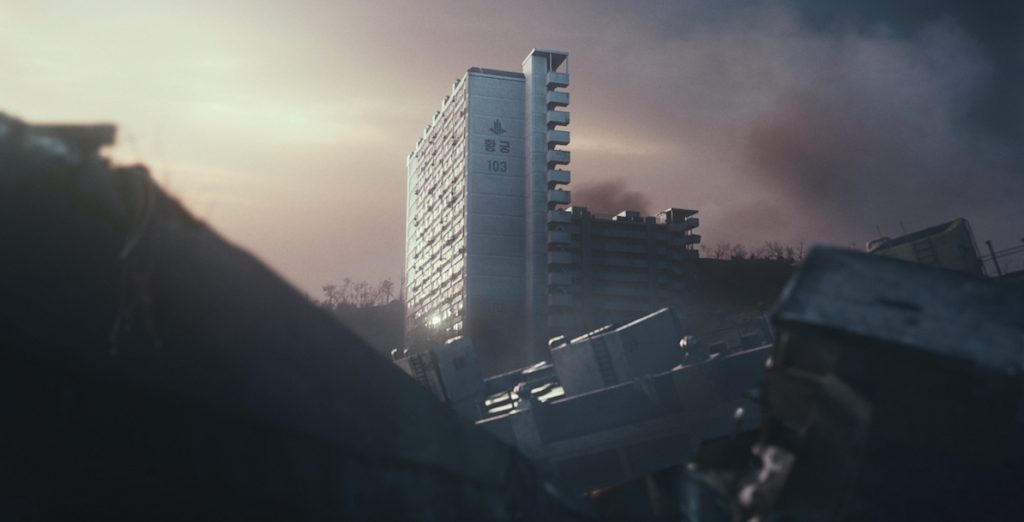
Concrete Utopia (Konkeuriteu yutopia, 2023) is a South Korean post-disaster survival drama, in which a massive earthquake destroys pretty much everything in Seoul with the exception of an apartment complex.
In an interview for the Fantastic Pavilion, director Um Tae-hwa recalled how this project originated from a webtoon – Korean comics designed to be read on smartphones –: “What was interesting about the webtoon (Kim Soong-nyung’s Cheerful Outcast Part II: Cheerful Neighbor) was that the disaster had already happened and there’s only one apartment building remaining. I thought that setting was very interesting. But before that, I was always interested in apartments in Korea. I was curious about the same-looking apartment buildings and why they keep demolishing the old ones and building new ones.”
Director Um added that his film “talks about the disaster, but the disaster stuff is not very important. It’s about the people who are in those circumstances and their stories.”
Concrete Utopia is nonetheless a large-scale movie with plenty of visual effects and sequences that show us the magnitude of the earthquake or take us to the post-apocalyptic environment. Um revealed that “it was a very big budget film in Korea, it was one of the tentpole and blockbuster films. There’s some kind of formula for summer blockbusters in Korea and it might not really go hand-in-hand with that. So there was a little bit of an anxious feeling about that, but because this fundamental story can be conveyed to the audiences, I thought that they would be able to really enjoy the film. There are still disaster scenes, I wanted them to have a very strong impact. I also wanted to convey the actual sentiment through the characters’ facial expressions, so instead of showing the whole picture, I left that up to the audience’s imagination, to make them think about what is actually happening in front of these characters.”
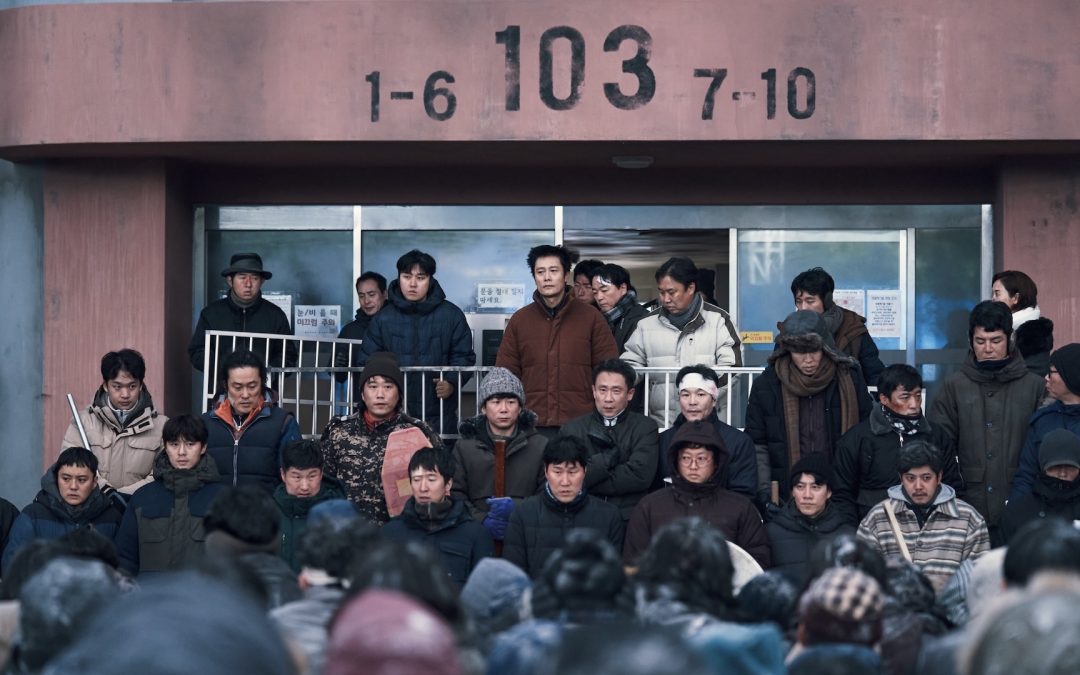
Among the protagonists of Concrete Utopia is a young married couple (played by Park Seo-joon and Park Bo-young) who own an apartment in the last standing building. Although he is reluctant, she doesn’t hesitate to provide shelter in their home to a mother and her child, who are part of the survivors who lost everything.
Eventually, problems linked to other “outsiders” lead residents to organize themselves. With a new delegate (Lee Byung-hun) at the helm, and after a majority vote, they decide to expel the non-residents – most of whom were more affluent before the disaster –. Thus begins a new era in the apartment complex, with greater security, units dedicated to different tasks, and a set of internal rules that seek to guarantee the survival of the residents only. The others are left out in the freezing cold.
Um commented that his focus was on “how these people react or make choices when they are in these extreme circumstances. I guess innately, once they are intimidated, they form this group and then they prefer to have a leader. Being in that group, they feel more comfortable. They also make this enemy and while standing against them, they become more unified. I didn’t want it to look like a conflict between good and evil. I just wanted very ordinary people making choices. Collectively, that could become evil in a way.”
Sooner rather than later, new conflicts arise in this community that for a moment seemed ideal. A unit needs to embark on increasingly difficult and hostile tasks to get food; some of the residents don’t follow the rules, express discomfort, or hide secrets. Throughout the film we continue to see regular people dealing with a desperate situation.
For Um, Concrete Utopia is “talking about human nature. The values are in conflict, between the world where the strong always wins and is about survival, versus respecting human dignity. Those two values are being conflicted in the film, because that’s a fundamental idea of it. It could apply to different societies around the world.”
When watching Concrete Utopia it’s, indeed, practically impossible not to think about its parallels with several real-world issues. Um stated that he “didn’t really consider the social phenomenon as part of the film. I was really focussing on the story,” but added that “the invisible fear within Korean society is the fear of not surviving. The apartment complex and its system encapsulates the current Korean society. They (the residents) are very focussed on making ends meet for their families and if that doesn’t happen, they become fearful. I’m sure that’s the same situation in other countries as well. I think this aspect actually ties in with a lot of social problems. There’s a war happening, the immigration issue, and more problems around the world. I want people to have a discussion. A discussion itself will contribute to making a better society.”
Concrete Utopia is South Korea’s official Oscar submission and it also got the seal of approval from Park Chan-wook, director of Oldboy (Oldeuboi, 2003), Lady Vengeance (Chinjeolhan geumjassi, 2005) and Decision to Leave (Heojil kyolshim, 2022). In fact, Um was Park’s assistant years ago: “Working with Park Chan-wook, I learned that instead of giving very detailed directions to crew and actors, he patiently suggests the direction that they should go. People feel more responsible because of that. That is based on trust, he trusts these people to do the right thing. I tried that process as much as I could in my film,” Um concluded.
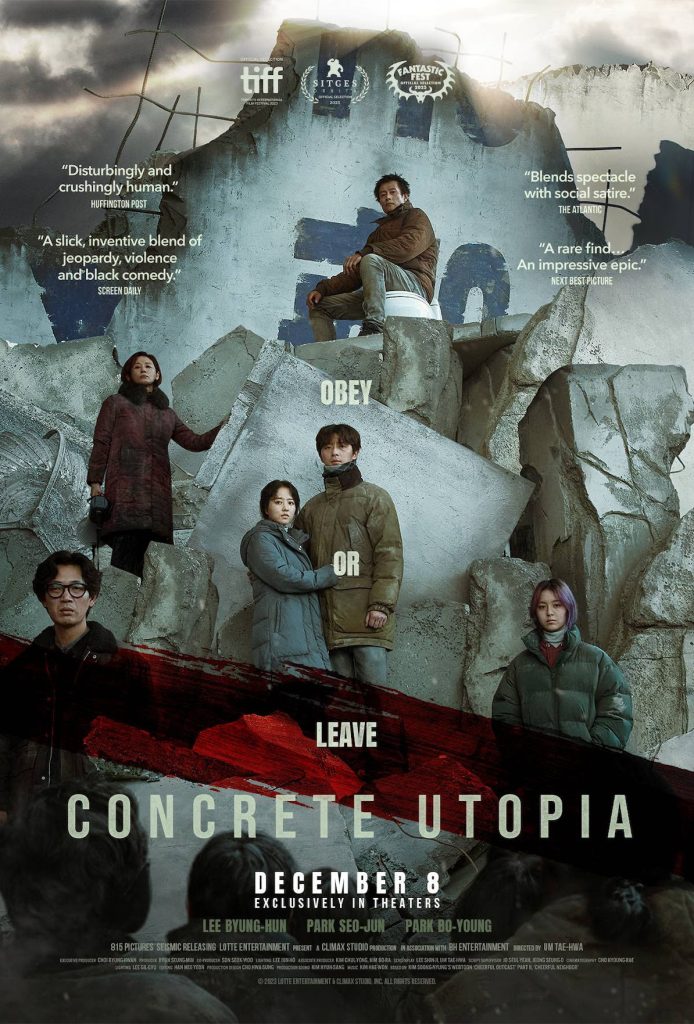
Concrete Utopia opens theatrically in New York and Los Angeles on December 8 and then expands to other U.S. cities on December 15.